
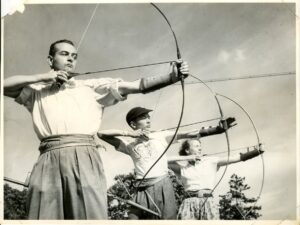
Our club founder Trevor Francis took up archery when he developed severe back problems after serving as a glider pilot in World War II. Contact sports like rugby and football had to be crossed off his to-do list – and archery took its place. Then he came up with the idea of forming a club – and the Bowmen of Bruntwood was created in 1950 in Trevor’s flat in Cheadle High Street. But thanks to founder member Ian Paton, who as the club’s first junior shot with Trevor in the newly-formed club in the early 1950s, we now know about Trevor’s war-time experiences…and they were hair-raising.
 There were near-death incidents that beg the obvious question: what if he’d not survived? No Trevor, no Bowmen of Bruntwood. It sounds brutal, but so was his war-time experience.
Trevor recalled those war-time exploits in The Eagle, the Glider Pilot Regimental Association’s magazine, and what a story he had to tell. It includes a training flight crash, sniper fire and machine gun bullets missing him by inches, a swim across the Rhine while completely naked, more than a week without food – and a final return home to be diagnosed with malaria, caught, it is thought, while living rough as he made his way back to safety.
Welsh-born Trevor was called up aged 18 at the start of World War II in 1939, joining the Duke of Lancaster’s Own Yeomanry TA (Territorial Army) a cavalry regiment later changing horses for artillery.
Trevor loved and rode horses, so this was a good first posting. But, helping take delivery of 180 horses off a train in Bury – and just two weeks into his army service – Trevor sustained his first “war wound.” Bitten by another horse, his own mount swung its head sideways and hit Trevor full in the face, knocking him out. There was no doctor available, so Trevor was treated by a vet.
Flying was always an ambition. He’d tried to join the RAF aged 16 but his father refused to sign the necessary papers. But now that he was a soldier, he was free to try again – and he enlisted in the Army Air Corps to train as a pilot in propeller-driven aircraft. He would later join the newly-formed Glider Pilot Regiment. But a training flight almost became his last.
With only seven and a half flying hours under his belt, Trevor was ordered to fly solo, and in what would be his last attempt at landing he crashed his aircraft on approach, clipping a tall tree, having both wings ripped off by the tree and a nearby brick tower, and the fuselage broken off just behind the cockpit by a second brick tower. The towers were part of a sewage farm, so Trevor really had landed in the….well, you know what I mean! But he walked away from the wreckage completely unharmed.
He thought that incident would mark the end of his flying career, but no, he was marked down as a future fighter pilot, although that possibility never transpired.
In June, 1944, Trevor experienced the frustration of never taking off to take part the D-Day invasion, spending three days sitting by the runway. But in September came Operation Market Garden, where Allied soldiers were tasked with securing all the bridges leading towards Germany – which they did bar Arnhem.
Trevor’s glider was towed by bomber into Holland. These large wooden gliders were designed to carry tons of equipment, crew and soldiers, then released several thousand feet above the landing zone. His aircraft ended up nose down after landing in a ploughed field with heavy equipment threatening to crush the crew. Like all glider pilots and crew, there was no way to fly back home – they had to take their chances on foot.
 Trevor may have been a good flier, but he was not a confident swimmer. So you can imagine how desperate he must have been to cross the Rhine with enemy machine gun fire aimed in his direction. Rather than wait in a long queue of soldiers to be ferried across, Trevor stripped naked and swam across the river with 30 others, seeing eight of them shot. He later managed to cover himself with a gas cape – used to protect men against chemical warfare – which he found in a crashed armoured vehicle.
Back in the UK, he discovered he was the only one of his group of nine glider pilots to return home, an experience which was to affect him for the rest of his life.
Then it was back into action again, crossing the Rhine, and with bullets piercing his glider cockpit inches from his face as he came into land. It was after this that Trevor came home to be diagnosed with malaria after he started shivering violently. Mosquito bites during a night in a forest were thought to be the cause.
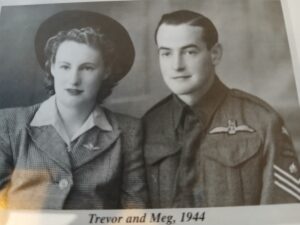
In one of his home postings, Trevor met his future wife, Meg, near Oxford, and they married in May, 1943. They were together for 72 years, with Trevor, who worked in the textile trade, retiring to Natal in South Africa, where he died aged 94.
It is thanks to Ian Paton that we first knew about Trevor. Having returned to the club after many years, Ian said he’d kept in touch with Trevor over the decades. Ian was sent a copy of the Eagle magazine at Trevor’s request, and this is how we’ve learned about his amazing war-time exploits.
I believe we all owe a huge debt to our brave founder who survived the crashes, the bullets and the privations of war to then create our wonderful club. He was a true action man.